The short answer
- You can snorkel the Great Barrier Reef every month of the year. There is no closed season.
- August to December is the best window: winds ease, visibility is good, the sea is warming.
- June to September has the clearest water and the roughest crossings. Both are the trade winds.
- Stinger season, November to May, changes what you wear, not whether you go. Suits are free.
- Yes, you can snorkel in July. The sea is around 24 °C and it's the driest stretch of the year.
The single most common worry we hear is that someone has booked the "wrong" month for the reef. Almost nobody has.
There's no closed season on the Great Barrier Reef, the water never drops below about 24 °C, and boats run every day of the year. What changes month to month is the wind, the water clarity and what you wear, not whether you can go.
Snorkelling here is genuinely year-round
Three facts do most of the work:
- Sea temperature runs from about 24 °C in July to close to 29 °C in January. Even the coldest month is warmer than most European summers.
- Air temperature barely moves. The average daily high ranges from 25.9 °C in July to 31.5 °C in January and December.
- Operators run all year. Cancellations are caused by wind and sea state, not by season.
So the question isn't whether to go, it's what to expect. Here's the month-by-month picture, with the climate figures from the Bureau of Meteorology's Cairns Aero station.
Quick picks
Every month works. These are the ones that work best, and how to adapt the rest.
- Best months overallAugust to DecemberCompare reef tours →
- If you're here in the wetA pontoon or the outer reef, not an inshore islandSee the day →
- Full climate figures83 years of Bureau of Meteorology dataSee the data →
On this page
Snorkelling the reef, month by month
| Month | Sea | Rain | Wind | What to expect on the water |
|---|---|---|---|---|
| January | ~29°C | 404.8 mm | Light | Warmest water, calm mornings, stinger suit, runoff can cut inshore visibility |
| February | ~29°C | 437.5 mm | Light | Wettest month. Quiet boats, warm water, occasional lost day |
| March | ~28°C | 422.1 mm | Light | Still wet, still warm. Good value, watch the forecast |
| April | ~27°C | 201.8 mm | Building | Rain drops sharply. One of the underrated months |
| May | ~26°C | 92.0 mm | Building | Dry season starts. Excellent all-rounder |
| June | ~25°C | 45.5 mm | Strong | Clear and dry, but the trades arrive. Wetsuit weather |
| July | ~24°C | 33.2 mm | Strongest | Coolest water, driest month, roughest crossings, busiest boats |
| August | ~24°C | 26.5 mm | Strong | Driest month of the year. Superb visibility on good days |
| September | ~26°C | 34.1 mm | Easing | Lowest humidity of the year. Our pick |
| October | ~27°C | 47.2 mm | Light | Warming water, easing wind, crowds gone. Our other pick |
| November | ~28°C | 87.9 mm | Light | Stinger season starts. Coral spawning around the full moon |
| December | ~31°C air | 193.8 mm | Light | Warm and building towards the wet. Good value early in the month |
Rainfall is the Bureau of Meteorology long-term average for Cairns Aero. Sea temperatures are approximate.
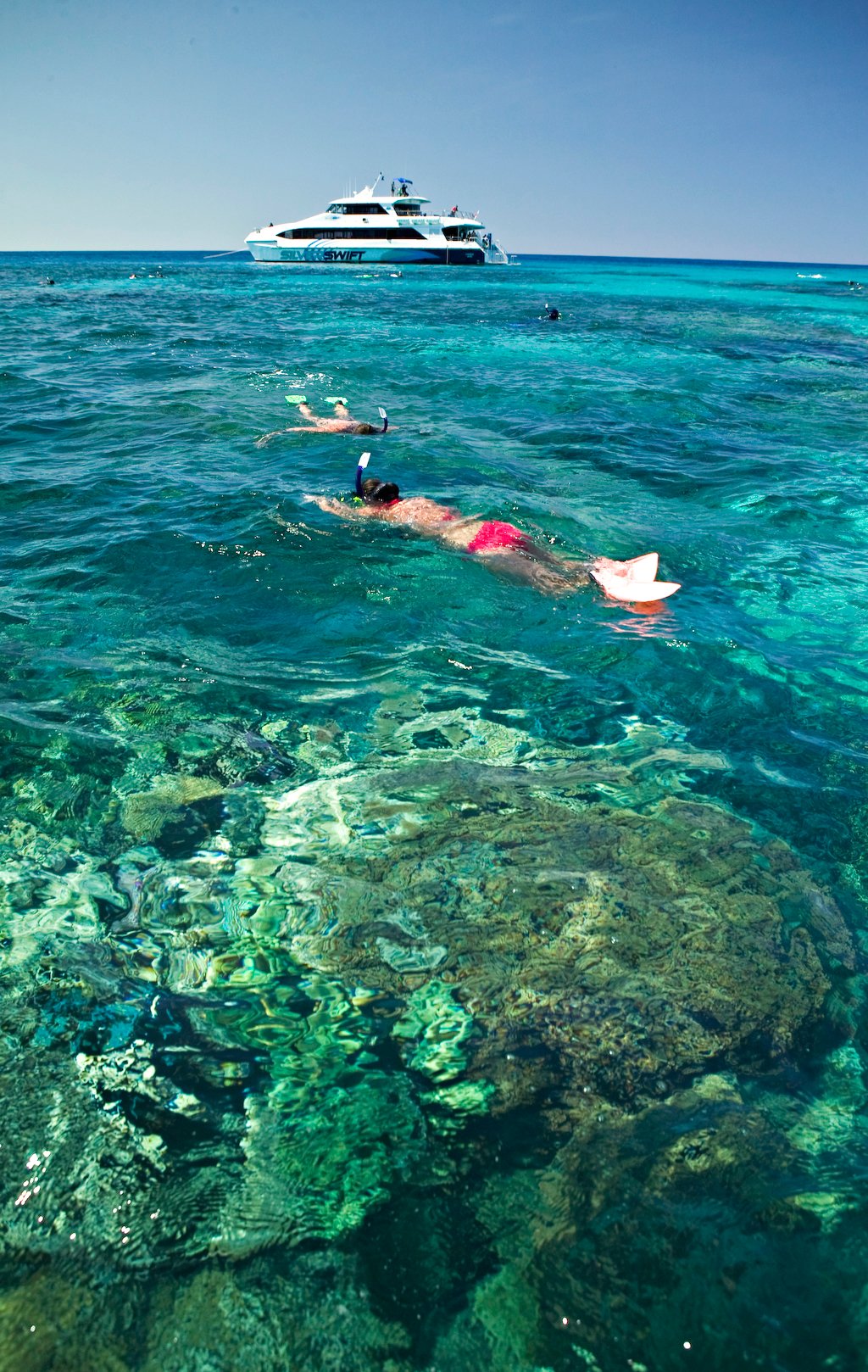
Can you snorkel the Great Barrier Reef in July?
Yes, and it's one of the most-asked questions about the reef, so let's answer it properly.
July is the driest stretch of the year: 33.2 mm across fewer than six rainy days, with the lowest humidity outside September and clear skies most days. On a good July day, visibility at the outer reef is as good as it gets.
The two caveats:
- The water is at its coolest, around 24 °C. Perfectly swimmable, but for a full day of floating still, most people are happier in a wetsuit. Operators hire them, and a lycra suit at minimum is sensible.
- The south-easterly trade winds are at their strongest. That means choppier crossings and the highest cancellation rate of the year. Take a seasickness tablet before boarding rather than after, and don't put the reef on your last day.
July is also peak season, so the good boats sell out. Book before you fly. Our guide to choosing a reef tour covers what to ask.
Wind matters more than rain
This is the thing visitors get backwards. People plan around the wet season and then get caught out in August.
Rain barely affects a reef day. You're underwater; whether it's raining on the surface is close to irrelevant, and cloud has little effect on colour at snorkelling depth. Operators don't cancel for rain.
Wind ends reef days. The south-easterly trades run strongest from June to September, and they cause choppy crossings, uncomfortable time at the mooring and the occasional cancellation. That's the dry season, the months everyone books.
The practical consequence: build a spare day into your trip and put the reef early. See how many days you need in Cairns.
If it's blowing, switch format rather than cancelling. A pontoon is a fixed platform and moves far less than a boat at anchor, and a half-day trip to a closer reef means less time crossing. Both are much more comfortable in 25 knots than a small catamaran at an outer mooring.
What actually affects visibility
- Distance offshore. The biggest single factor. The outer reef, 40 to 70 km out, is far less affected by river sediment than an inshore island. In a wet week, favour the outer reef over Green Island.
- Recent heavy rain. Sustained rain pushes sediment out from the rivers. A single shower makes no difference; four days of it does.
- Wind and swell. Churned-up water is murkier water, particularly in shallow areas.
- Tide. Matters most at inshore and fringing reef, where a low tide can mean very little water over the coral.
- Not cloud. Overcast days are fine. This surprises people.
Stinger season, and what it changes
Stinger season runs roughly November to May. Box jellyfish and Irukandji are coastal animals, which is why the mainland beaches have netted enclosures in those months.
On the reef, the picture is different: they are very rare at the outer reef, which is deeper, more open and much less hospitable to them. Every operator supplies full-body lycra suits free of charge during the season, and most guests wear them year-round because they're the best sun protection available.
So stinger season changes what you wear and nothing else. The detail is in our stinger season guide.
The best months, ranked
September and October, our pick
Rain at 34.1 and 47.2 mm, the lowest afternoon humidity of the year at 55%, trade winds easing off, water warming back past 26 °C, and the school-holiday crowds gone. If we were choosing a fortnight for the reef, it would be here.
November and December, the value window
Warm water, light winds, and prices off their peak before Christmas. Stinger suits are supplied. Coral spawning happens around the full moons of late spring, which is a genuinely strange thing to be in the water for.
August, the driest, if you accept the wind
26.5 mm of rain across 4.9 days is the driest month of the year, and on a calm August day the visibility is exceptional. You're gambling on the trades and paying peak prices.
April and May, underrated
Rain falls off sharply from 201.8 mm in April to 92 mm in May, the water is still 26–27 °C, and the trades haven't arrived. Fewer people than mid-year.
January to March, cheapest, warmest, wettest
Warmest water of the year and the calmest mornings, against 400 mm-plus months and the cyclone window. Favour the outer reef over inshore islands, and buy travel insurance.
June and July, peak season, peak wind
Clear and dry, coolest water, roughest crossings, busiest boats and highest prices. Perfectly good; just not the bargain the weather suggests.
Whatever month you're here, the boat matters more
Crossing time, passenger numbers and how many reef sites you visit change the day far more than the month does. Compare them properly.
Compare reef tours →How we know this
Climate figures are long-term averages from the Bureau of Meteorology's Cairns Aero station, which has 83 years of record. The interpretation, what each month feels like on a boat, comes from being on the water here most weeks of the year.
Averages are not forecasts, and conditions on any given day depend on wind, tide and recent rain.
Snorkelling the reef month by month: our verdict
You can snorkel the Great Barrier Reef in any month, and almost nobody has booked the wrong one. The best window is August to December, and our own pick is September and October: low rain, the lowest humidity of the year, easing winds and warming water. July works: it's the driest stretch, the sea is around 24 °C and you'll want a wetsuit. And remember it's wind, not rain, that cancels boats.