The short answer
- Stinger season runs roughly November to May in Far North Queensland.
- Reef tours run all year. Operators supply full lycra stinger suits and everyone wears them.
- Risk is much lower on the outer reef, 40–70 km offshore, than at coastal beaches.
- In town: the Esplanade Lagoon is always safe, and beaches have netted enclosures.
- It changes what you wear, not whether you go.
If you've been reading about Cairns you've probably hit some alarming pages about jellyfish. Here's the calm version, from people who swim here all year.
Stinger season is real and worth respecting. It is also completely routine to work around, and it stops almost nobody from snorkelling the Great Barrier Reef.
When is stinger season in Cairns?
Roughly November to May, overlapping the wet season. The exact window shifts year to year with water temperature, which is why you'll see slightly different dates quoted. Treat November through May as the season and June through October as clear.
During those months, marine stingers are present in coastal waters, beaches, estuaries and inshore areas. This is when netted swimming enclosures go up at the patrolled beaches and every reef boat hands out lycra suits.
Quick picks
Your options, whichever month you're travelling.
- Reef trips run year-roundStinger suits included, all operatorsSee reef tours →
- Stinger-free monthsJune to OctoberBest time to visit →
- Always-safe swimmingFreshwater falls and swimming holesSee the falls day →
On this page
What the stingers are
Two species matter here:
- Box jellyfish: larger, found in shallow coastal water, especially near river mouths and after rain. A sting is painful and potentially serious, which is why the nets and suits exist.
- Irukandji: very small, sometimes found further offshore. Stings are initially mild but can cause a delayed and unpleasant reaction, so they're taken seriously.
Both are seasonal, both are far more common inshore than out on the outer reef, and both are effectively handled by a full-body lycra suit.
Can you still snorkel the Great Barrier Reef in stinger season?
Yes, and thousands of people do it every day of the season. Nothing about a reef trip changes except your clothing.
- Every operator provides full lycra stinger suits at no extra cost, in season.
- Crew brief everyone before entry, and lookouts watch the water.
- The outer reef, 40–70 km offshore, has a much lower stinger presence than coastal beaches.
- Boats carry vinegar and first-aid, and crew are trained for it.
If you'd rather not be in open water at all, pontoon tours give you a semi-submersible and an underwater observatory, so you can see coral without getting in. Our reef tour comparison flags which boats are pontoon-based.
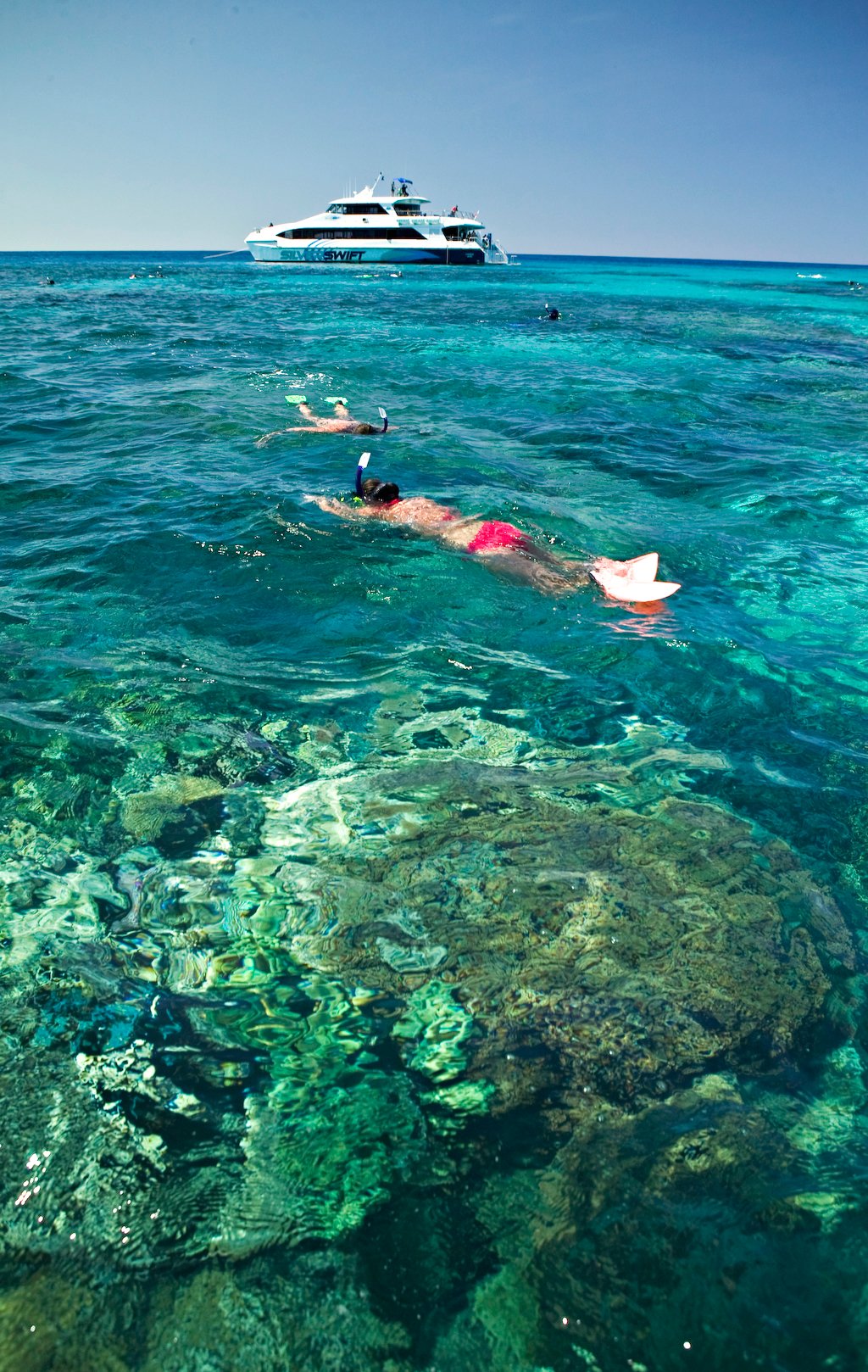
Wear the suit even outside stinger season. It's also sun protection, and a couple of hours face-down on the reef is exactly how people burn their backs. Most regulars wear lycra year-round for that reason alone.
Where you can swim safely in stinger season
| Where | Safe in stinger season? | Notes |
|---|---|---|
| Esplanade Lagoon, Cairns | Always | Free, patrolled, chlorinated saltwater. The default. |
| Netted beach enclosures | Yes, inside the net | Palm Cove, Northern Beaches, Four Mile Beach |
| Outer reef, in a lycra suit | Yes, standard practice | Much lower risk than inshore |
| Hotel and resort pools | Always | Obvious, but worth stating |
| Freshwater falls & swimming holes | Yes, no marine stingers | Atherton Tablelands, Behana Gorge, Babinda |
| Unpatrolled beaches | Not recommended | Especially near river mouths and after heavy rain |
| Rivers and estuaries | Never | Crocodiles, year-round, unrelated to stingers |
The freshwater option is the one people overlook. The Atherton Tablelands waterfall circuit and the gorge swimming holes south of Cairns have no marine stingers at all, and they're at their best in exactly the months stinger season covers. See the waterfalls day or Behana Gorge canyoning.
How stinger suits work
A stinger suit is a thin, full-length lycra layer covering ankles to wrists, usually with a hood. It's not a wetsuit. There's no thermal function, and it's light enough that you barely notice it once you're in.
It works because stinger tentacles need contact with bare skin to fire. Cover the skin and the mechanism doesn't work. That's why a lycra layer is effective despite being thin.
Practical notes: they're provided free in season on every reef tour we book, they come in all sizes including children's, and they double as sun protection. You don't need to buy your own.
What to do if you're stung
Rare on a guided reef trip, but worth knowing:
- Get out of the water and tell crew or a lifeguard immediately.
- Douse with vinegar: every boat and patrolled beach carries it. Don't rub the area.
- Don't use fresh water on the sting; it can make things worse.
- Follow crew instructions. They're trained for this and it's a routine part of the job.
- Seek medical help for anything more than a mild sting, particularly if symptoms appear later. That's the irukandji pattern.
Perspective: reef operators run trips through stinger season every year with suits, briefings and vinegar as standard. The precautions are why serious incidents on guided reef tours are very rare.
Should stinger season change your travel dates?
Only if beach swimming is the point of your trip. If you're coming for the reef, the rainforest and the islands, stinger season is a non-issue: you'll wear a suit on the boat and swim in the lagoon in town.
If you specifically want to swim off an open beach without a net, come June to October. That's also the dry season, which means calmer reef crossings and better visibility, so it's the better window anyway for other reasons. Our month-by-month guide covers the trade-offs.
How we know this
We book reef and island tours through every month of the year, including the whole stinger season, and we swim here ourselves. The practical detail here is what operators do on the boats, not a summary of warning signage.
This is general guidance for planning, not medical advice. Always follow local signage, lifeguards and your crew.
The short version on stinger season
Stinger season runs roughly November to May, and it changes what you wear rather than whether you go. Every reef operator supplies a full lycra suit free in season, the outer reef carries much lower risk than coastal beaches, and the Esplanade Lagoon and netted enclosures cover you in town. If swimming off an open beach matters to you, come June to October, which happens to be the better reef window anyway.