The short answer
- Pick the boat, not the price. The gap between a good operator and a bad one is bigger than the gap in cost.
- Decide one thing first: pontoon, dive boat, sailing catamaran, or island. They're four different days.
- Check passenger numbers, not just the vessel size. 40 people on a big boat beats 100.
- Confirm the reef tax is in the price. If a quote looks impossible, this is usually why.
- Two or three reef sites beats one: unless someone in your group isn't swimming.
There are more reef operators in Cairns than anywhere else on the Australian coast, which is excellent news and a genuine problem. Thirty boats leave the Reef Fleet Terminal most mornings and the marketing for all of them says the same six things.
We book these boats every week. This is how we choose, in the order the decisions matter.
Four types of reef day: decide this first
Everything else follows from this. These aren't tiers of quality, they're different products.
| What it is | Best for | Weak point | |
|---|---|---|---|
| Pontoon | Fixed platform at one reef, with a lagoon, glass-bottom boat and semi-sub | Families, non-swimmers, mixed groups, anyone nervous | One site, so less coral variety |
| Dive & snorkel boat | Fast catamaran to two or three moorings | Confident swimmers, certified divers, best coral | Nothing to do between sites but sit |
| Sailing catamaran | Sails to a cay and a reef site, usually smaller numbers | A quieter day, couples, people who like being under sail | Slower, so less time in the water |
| Island day | Ferry to Green or Fitzroy Island, reef off the beach | Beach time, budget, half-day flexibility, small children | Inshore reef, not outer reef |
Our full side-by-side is on the reef tours page, and the island options are compared separately.
If you get this one right, almost any reputable operator in that category will give you a good day. Get it wrong, a nervous first-timer on a dive boat, or a keen snorkeller on a pontoon, and no amount of operator quality fixes it.
Compare within categories on our reef tour page and our island tours page.
Quick picks
The single decision that shapes the whole day.
- If you want the best coralA dive-led boat visiting two or three sitesSee the day →
- If not everyone swimsA pontoon, lagoon, glass-bottom boat, semi-subSee the day →
- If you want it quietA sailing catamaran with a smaller passenger capSee the day →
On this page
The eight questions worth asking
How many reef sites, and which ones?
Two or three moorings gives you variety and a second chance if the first site is murky. One site is fine on a pontoon, where the facilities are the point. Named reefs on the itinerary, Flynn, Milln, Thetford, Saxon, Hastings, Norman, Moore, Upolu, are a good sign; "the outer reef" with no names is less so. Conditions decide the actual reef on the day, so treat any itinerary as an indication.
How many passengers, and what's the crew ratio?
This is the number operators are least keen to put in marketing and it changes the day most. Ask it directly.
How long is the crossing?
45 minutes to 90 minutes each way. The difference is an hour and a half of water time. Our guide to how far the reef is has the times boat by boat.
Is the reef tax included?
The Environmental Management Charge is compulsory for every commercial reef visitor. Reputable operators fold it into the advertised price. A price that looks impossibly cheap usually has this, gear hire and lunch sitting outside it.
What's the lunch, honestly?
A hot buffet and a sandwich in a bag are both described as "lunch included". It's a fair proxy for how the whole operation is run.
Is there a marine biologist or guide on board?
A guided snorkel tour, sometimes free and sometimes a small add-on, converts the day for nervous swimmers and for anyone who wants to understand what they're looking at. On the boats that do it well, it's the best value on the whole ticket.
What's the wetsuit and stinger suit policy?
Full-body suits should be free during stinger season, roughly November to May. Wetsuit hire in the cooler months is often an extra. Worth knowing before you're standing on the dive deck.
What happens if it's cancelled?
Wind cancels boats, particularly June to September. You want a clear refund-or-rebook answer, and you want the reef booked early in your trip so rebooking is possible.
Passenger numbers, and why they matter more than the boat
A reef day has three bottlenecks: the gear station, the ladder, and the water directly above the coral. All three scale with passenger numbers, not vessel size.
What it looks like in practice. On a boat of 40, you get in when you want to, the crew learn your name, and the guided snorkel has six people on it. On a boat of 120, you queue for fins, you queue for the ladder, and the guided snorkel is a crowd. Same reef, same weather, entirely different day.
Smaller boats cost more. This is the one place we'd tell you to spend the extra money rather than save it, and it's why the sailing catamarans with lower passenger caps have such loyal repeat customers.
The question that gets you a straight answer: not "how big is the boat" but "how many passengers are booked on my date, and how many crew?" Operators know both numbers. We ask it for every booking we make.
One site or three?
More sites is better, with one clear exception.
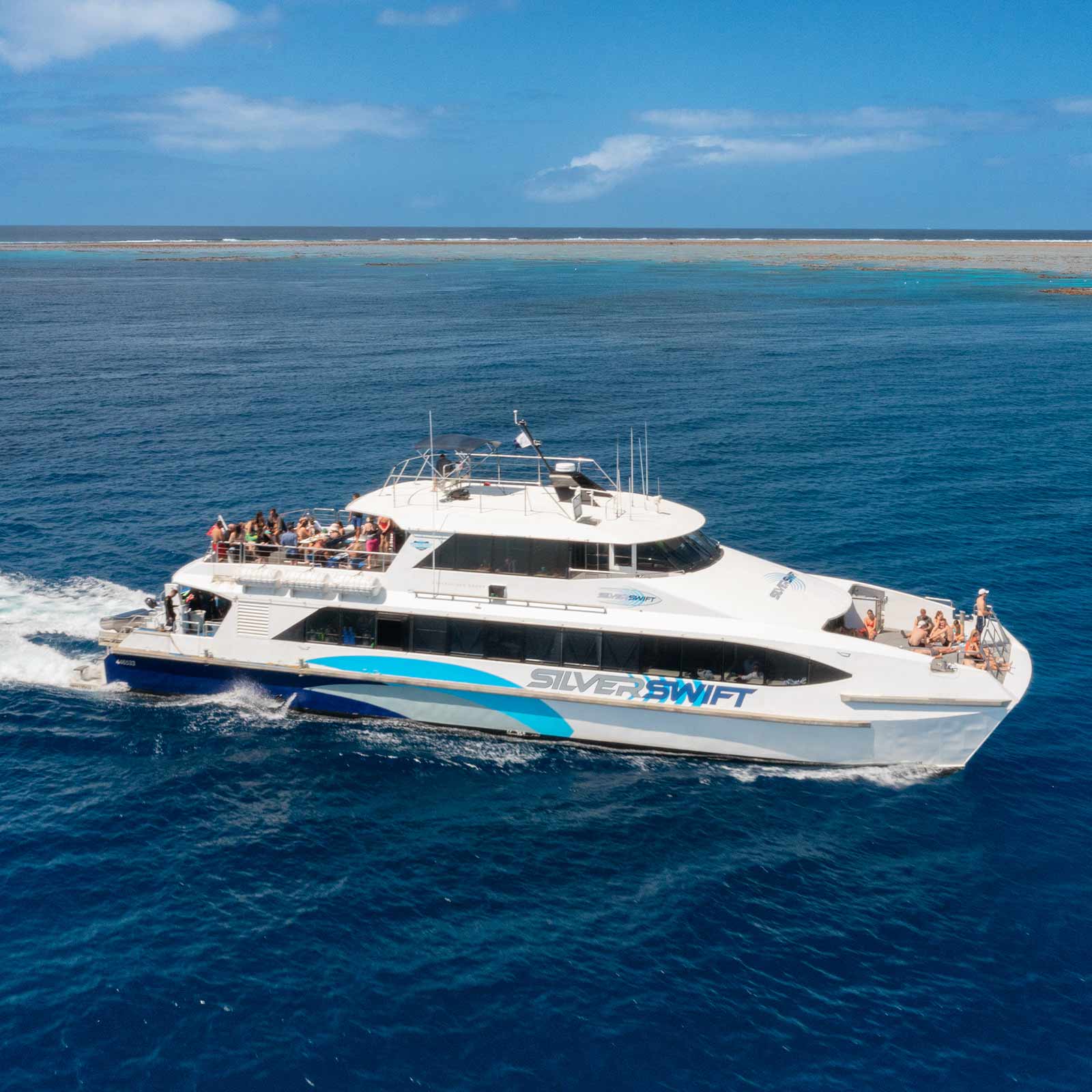
Take two or three sites if everyone in your group will get in the water. Coral varies enormously over a few kilometres, visibility varies with the tide, and a second mooring is insurance against a mediocre first one. Silverswift at $308 does three, which is unusual for a day trip and the reason certified divers pick it.
Take a single-site pontoon if anyone won't. On a pontoon the non-swimmers get a glass-bottom boat, a semi-submersible, an underwater observatory and somewhere shaded to sit down. On a three-site dive boat they get eight hours on a moving vessel. That trade is worth more than coral variety. The family version of this is in Cairns with kids, and the non-swimmer version in is it safe to snorkel the reef.
What's included, and what gets charged at the wharf
Sticker prices in Cairns are misleading because operators bundle differently. Two quotes $50 apart can end up $150 apart by the end of the day.
| Item | Usually included | Often extra |
|---|---|---|
| Return boat travel and reef moorings | ✓ | |
| Snorkel gear: mask, snorkel, fins, flotation vest | ✓ | |
| Lycra stinger suit in season | ✓ | |
| Lunch, morning and afternoon tea | ✓ on most | On the cheapest tickets |
| Environmental Management Charge (reef tax) | ✓ on reputable operators | On suspiciously cheap tickets |
| Guided snorkel tour with a marine guide | On some | Small add-on on others |
| Wetsuit hire outside stinger season | ✓ | |
| Introductory or certified dive | ✓, $90–$158 intro | |
| Glass-bottom boat or semi-sub | ✓ on pontoons | On some boats |
| Underwater photo package | ✓ | |
| Hotel transfers | On some | ✓ often, and from the northern beaches |
Full line-by-line comparison in our reef tour cost breakdown.
The sanity check we'd apply: add up the extras you'd realistically buy, transfers, one dive, gear hire, and compare the totals rather than the headline. Our reef tour cost breakdown does that arithmetic for each type of trip, and is Cairns expensive puts it in the context of the whole trip.
How to read reef tour reviews
Star ratings for Cairns reef boats cluster between 4.4 and 4.9, which makes them close to useless for choosing. The useful signal is the shape of the complaints.
- "Too crowded" appearing repeatedly is the single most reliable negative signal. It's a structural problem, not a bad day.
- "Rough crossing" is weather, not the operator. Discount it, unless several reviews mention nobody warned them.
- "Coral wasn't as colourful as expected" is usually the reviewer, not the reef. Healthy hard coral is brown, cream and olive; the neon in the brochures is soft coral and clever lighting.
- Crew named individually in positive reviews is a genuinely good sign. It means small enough numbers that people remember.
- Recent reviews only. Boats change hands, refit and change crew. Anything older than about 18 months tells you little.
Set a rating floor and then read the three-star reviews. That's where the real information is.
Want us to match the boat to your group?
Tell us who's coming and how confident they are in water, and we'll tell you which of these boats fits, including the passenger numbers on your date.
Compare reef tours →Five ways people pick badly
Booking on price alone
The cheapest ticket usually means the most passengers, the longest crossing, and gear hire on top. You save $60 and lose two hours of water time.
Putting a nervous swimmer on a dive boat
A ladder into open water is a very different proposition from steps into a pontoon lagoon. Ask the nervous person, not the keen one, which boat you're booking.
Booking the reef for the last day
Wind cancels boats. If your reef day is the day before you fly, a refund is all you'll get. Put it early, see how many days you need.
Ignoring the transfer question
Staying at Palm Cove and booking a boat that doesn't pick up from the northern beaches costs you a taxi at 7am, each way. Check first, our northern beaches guide covers this.
Booking a dive within 24 hours of flying
You can't fly within 24 hours of diving. If you want to dive, it can't be your last day. See our diving guide.
How we know this
We're based in Cairns and we book these boats every week, for guests ranging from certified divers to people who tell us upfront they can't swim. The criteria above are the ones we apply, in that order. The regulatory points, the reef tax and the snorkelling code of practice, are Queensland requirements rather than our interpretation.
Passenger numbers, inclusions and prices vary by season and date. We confirm them for your booking.
How to choose a Great Barrier Reef tour: our verdict
Decide the format first, pontoon, dive boat, sailing catamaran or island, because that's the decision that shapes the day. Then ask two questions the marketing won't answer: how many passengers on my date, and how many reef sites. Confirm the reef tax is in the price, book the reef early in your trip, and if anyone in your group is unsure about the water, let them choose the boat.