The short answer
- Yes. Reef snorkelling from Cairns is a heavily regulated, guided activity, and thousands of people do it every day.
- You don't need to be a strong swimmer. Flotation vests, pool noodles and lifejackets are standard, and staff put nervous swimmers in them as a matter of course.
- You don't need to swim at all. Glass-bottom boats, semi-submersibles and pontoons let you see the reef dry.
- Stingers are a coastal problem, not an outer reef one, and full-body suits are supplied free from November to May.
- The real risks are sunburn, seasickness and overestimating your fitness. All three are manageable.
Almost everyone who asks us this is really asking one of two more specific questions: am I a good enough swimmer for this, or is something in the water going to hurt me. Both have straightforward answers, and neither should stop you going.
Here's what a reef day is genuinely like from a safety point of view, including the bits operators don't put in the brochure.
How a reef day is regulated
Yes. Commercial snorkelling in Queensland runs under a state recreational diving and snorkelling code of practice, and the rules are visible in how a reef day is run: a compulsory medical questionnaire, a full briefing before anyone gets in, a marked snorkel area, and dedicated in-water and on-deck lookouts whose only job is watching people.
Snorkellers assessed as higher risk, weak swimmers, certain medical conditions, anyone who says they're unsure, are required to wear a flotation device, and on many boats a differently coloured vest or snorkel so the lookout can pick them out instantly from the deck. It is not a judgement on you. It's routine, and it's the single reason the safety record is what it is.
Answer the medical form honestly. It's the one part of the day where being vague works against you.
Quick picks
Three ways to see the reef, ranked by how much swimming they need.
- Best if you're a nervous swimmerA pontoon, a fixed platform with a shallow entrySee the pontoon day →
- Best if you can't swim at allGlass-bottom boat and semi-sub, no water neededSee the day →
- Best short, calm introductionA half-day trip to a sheltered inner reefSee half-day tours →
On this page
Do you need to be a good swimmer to snorkel the reef?
No, and this surprises people. Snorkelling isn't swimming. With a mask, a snorkel and a flotation vest you float face-down and look; you barely move. Plenty of guests who describe themselves as weak swimmers have a perfectly good day.
What you do need is to be honest about it, so the crew can set you up properly. Tell them at the briefing. What they'll offer:
- A flotation vest: an inflatable one you can adjust in the water, so you can't sink.
- A pool noodle: the most underrated piece of reef equipment there is. Tuck it under your arms and you're stable.
- A lifejacket, if you'd rather not think about it at all.
- A guided snorkel tour: a marine guide leads a small group on a set route, often towing a float ring you can hold. On most boats this is either free or a small add-on, and for a nervous first-timer it's the best money you'll spend.
- A lagoon or shallow entry: on a pontoon you walk down steps into waist-deep water rather than jumping off a moving boat.
The one tip that changes everything: put your face in and breathe through the snorkel while you're still holding the ladder. Thirty seconds of that and your brain accepts it. Most panic on the reef is the first-breath moment, not the water.
If you can't swim at all: you can still see the reef
This is worth saying plainly, because a lot of people write off the reef entirely. You do not have to get in the water.
| Option | Do you get wet? | What you see | Best on |
|---|---|---|---|
| Glass-bottom boat | No | Coral gardens and fish directly below you | Pontoon and island tours |
| Semi-submersible | No | Seated below the waterline, big windows, guide commentary | Pontoon tours |
| Underwater observatory | No | Fixed window into the reef | Pontoon tours |
| Pontoon lagoon / shallow entry | Yes, waist-deep | Coral from a standing depth | Pontoon tours |
| Guided snorkel with a float ring | Yes | The real thing, with a guide holding the float | Most reef boats |
| Introductory scuba dive | Yes | The reef at depth, no certification needed | Most reef boats |
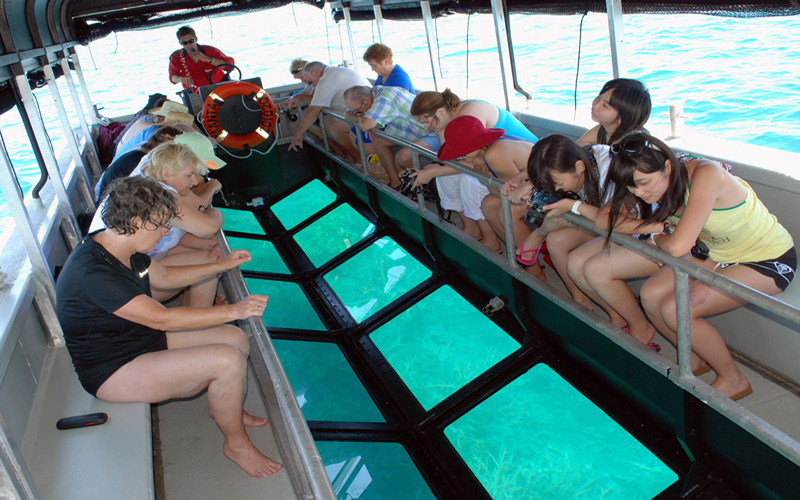
If someone in your group can't or won't get in the water, book a pontoon day. A pontoon is a fixed platform moored at the reef with a lagoon, a glass-bottom boat, a semi-sub and usually an underwater observatory, so the swimmers and the non-swimmers both get a full day out of it. Reef Magic and Sunlover are the two we send families and mixed-confidence groups to most often.
What's in the water with you
Short answer: fish, coral, turtles and the occasional reef shark, none of which are interested in you.
Sharks
You may well see a whitetip or blacktip reef shark. They are small, shy and a good day out. Shark incidents on the outer reef during snorkel tours are not a thing operators plan around, and the reef sites Cairns boats use have no history of them.
Coral
The most common reef injury by a wide margin is a coral cut or graze, and it happens because someone stood on or grabbed the reef. Cuts from coral get infected easily. Don't touch anything, and keep your fins up and away.
Stonefish, cone shells and other things you'd have to touch
Real, and all avoidable by the same rule: hands off, feet off. Nobody snorkelling in open water over a reef bommie is going near one.
Sun
This is the actual injury of the day. You're floating face-down in tropical sun with water reflecting it back, and you can't feel it burning. Wear the supplied suit or a rash vest, use reef-safe sunscreen on the back of your neck and legs, and reapply.
Seasickness
The outer reef is a 90-minute to two-hour crossing and it can be rough, particularly in the trade winds from June to September. Take tablets before you board, not once you feel unwell, sit low and central, and stay on deck in fresh air. Every boat carries tablets, and the crew have seen it all before.
Getting tired and drifting
Currents at reef sites are usually mild, but they exist. Stay inside the marked area, and check your position against the boat now and then instead of following the fish. If you get tired, roll onto your back, float, and raise one arm. That's the signal, and the lookout will come to you.
Nervous about your first time in the water?
A pontoon gives you a shallow lagoon entry, a glass-bottom boat and a semi-submersible, so you can build up to snorkelling at your own pace, or skip it entirely and still see the reef.
Compare reef tours →Stingers, and the suit you'll be given
Box jellyfish and Irukandji are coastal animals. They're the reason the beaches near Cairns have nets from roughly November to May, and they are very rare at the outer reef, which is deeper, more open and much less hospitable to them.
Every reef operator supplies full-body stinger suits free of charge during the season, and most guests wear them all year because they double as sun protection. Wearing one is a good idea in July too.
The full picture, month by month, is in our Cairns stinger season guide. The short version: stinger season is a reason to wear the suit, not a reason to skip the reef.
Age limits, children and snorkelling
There's no single legal minimum age for snorkelling on the reef, and operators set their own rules. In practice:
- Most reef boats take children from around 4 years old as paying passengers, with parents responsible for them in the water.
- Children snorkel in a flotation vest and on most boats that isn't optional.
- Pontoons suit young families best: a lagoon with a shallow entry, shade, toilets, a dry option and somewhere to sit down beats a small boat with a ladder.
- Introductory scuba usually starts at 12 and certified diving at 12 with restrictions.
- Some boats are adults-only or 18+. Check before you book, or let us do it.
We've put the family-specific version of this together in Cairns with kids. If a specific boat's minimum age matters to your booking, we'll confirm it with you when you book.
Is diving the Great Barrier Reef safe?
Yes, with the same caveat: it's regulated, and the regulation is the point. An introductory dive needs no certification, you get a briefing, a wetsuit, and a dive instructor who stays with you and controls your buoyancy in shallow water. Group sizes are small, usually one instructor to two or four divers.
There's a medical questionnaire, and it's stricter than the snorkelling one. Asthma, heart conditions, recent surgery, pregnancy and some medications can mean a doctor's sign-off or a no. Declare everything; getting turned away at the dive deck is much better than the alternative.
Two practical rules people forget: don't dive within 24 hours of flying, which matters if your reef day is the day before you leave, and don't dive with a head cold. If you'd like to try, the boats that do it best are on our reef tour comparison; Down Under Cruise and Dive and Silverswift are both dive-led operations.
How to pick a boat if you're nervous
Pick a pontoon over a dive boat
A fixed platform doesn't move with the swell the way a moored catamaran does, and a lagoon entry is far less confronting than a ladder into open water. It also gives you dry alternatives when you've had enough.
Or pick a half-day to an inner reef
Shorter crossing, calmer water, less commitment and roughly half the price. Norman and Upolu are closer in and more sheltered than the outer sites. See our half-day reef tours.
Book the guided snorkel tour
A guide, a small group, a float to hold and a set route. If you're anxious, this converts the day.
Go early in your trip, not late
If the weather cancels you or you have a bad day, you want another shot at it. It also keeps you clear of the no-diving-before-flying rule.
Choose a smaller boat if seasickness is the worry, not a bigger one
It sounds backwards, but a fast catamaran with a shorter crossing often beats a big slow vessel that rolls. What matters most is getting to the water quickly.
Say you're nervous at the briefing
Every crew on every boat we book has heard it a hundred times, and it changes how they look after you for the rest of the day.
How we know this
We're based in Cairns and we book these boats every week, including for guests who tell us upfront they can't swim. The safety framework described here is Queensland's code of practice as it plays out on the water, and the equipment list is what these operators actually hand out.
This is general information, not medical advice. Declare all medical conditions on the operator's form and follow the crew's instructions on the day.
Is it safe to snorkel the Great Barrier Reef? Our verdict
Yes. It's guided, regulated, and set up specifically for people who aren't confident in water, flotation vests and pool noodles are standard, and staff would rather put you in one than watch you struggle. If you can't swim at all, book a pontoon and use the glass-bottom boat, the semi-sub and the shallow lagoon. Wear the stinger suit, wear sunscreen, take a seasickness tablet before you board, and don't touch the coral. That's the whole safety brief.