The short answer
- You don't need to be certified. An introductory dive takes anyone with an instructor in shallow water.
- Cairns is one of the cheapest places in the world to get certified: PADI says as little as 2 to 4 days.
- Add a dive to a day boat for roughly $90–$158 on top of the trip price.
- The outer reef sites are 40–70 km offshore: Flynn, Milln, Thetford, Saxon, Hastings, Norman.
- Don't fly within 24 hours of diving. Plan the dive early in your trip, not the day before you leave.
Cairns is the busiest dive port in Australia, and that's a mixed blessing: enormous choice, a lot of noise, and a price range wide enough to be confusing. The reef in front of it is genuinely excellent, and the practical barriers to getting under it are lower than most people assume.
Here's how diving works from here, whether you've never breathed off a regulator or you've got a hundred logged dives.
You don't need a certification to dive the reef
This is the thing people don't know, and it changes trips. An introductory dive requires no qualification and no prior experience. You do a briefing on the boat, get fitted with a wetsuit and gear, and an instructor takes you into shallow water and stays with you, managing your buoyancy while you look at coral.
Group sizes are small, usually one instructor to two or four guests, and the dive itself runs around 20 to 30 minutes at modest depth. It's available as an add-on on virtually every reef day boat out of Cairns.
The honest expectation-setting: an intro dive is not the same as diving. You won't control your own buoyancy or navigate. What you will do is spend half an hour breathing underwater on the Great Barrier Reef, which for most people is the memory of the trip.
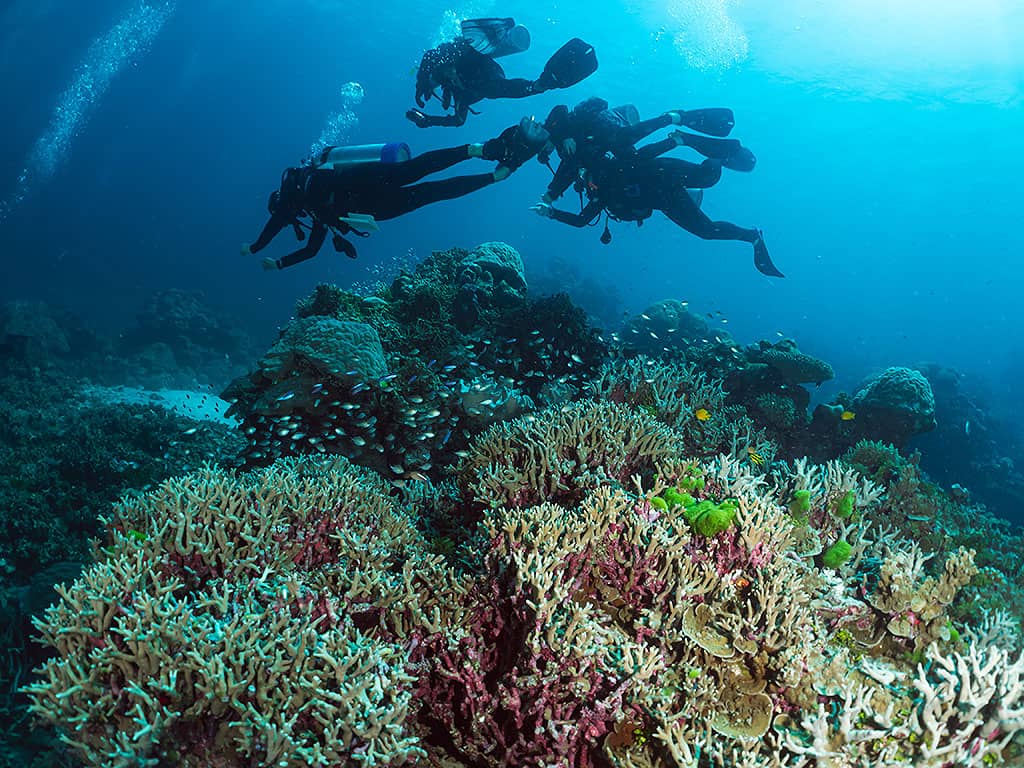
Quick picks
Three routes onto the reef with a tank, depending on where you're starting.
- Best day boat for diversSilverswift, three sites in one daySee the day →
- Best for your first ever diveDown Under Cruise & DiveSee the day →
- Best value if you're seriousA liveaboard, more dives, less travelSee the liveaboard →
On this page
Learning to dive in Cairns
Cairns is one of the best places in the world to get an open-water certification, for three reasons: warm water, sheltered training conditions, and enough competition to keep prices honest.
PADI's own guidance is that you can learn to dive in as little as two to four days. Structurally, a course splits into three parts:
- Theory: usually done online before you arrive, which shortens the in-water part. Do this at home if you can; it's a poor use of a Cairns morning.
- Confined water: skills practice in a pool or sheltered shallows.
- Open water dives: on the reef, either from a day boat over two days or from a liveaboard.
Two decisions matter more than the price. First, day boat or liveaboard: a liveaboard course gets you more dives in less travel time and is the better learning experience, but you're committed to the boat. Second, class size: four students to an instructor is a very different course from eight.
Get the theory done before you fly. Every hour you spend on a laptop in Cairns is an hour you're not on the reef, and the online component is identical wherever you do it.
What diving the reef costs
Diving is priced as an add-on to a day trip, not as a separate product, which trips people up when they compare quotes.
| Typical cost | What it is | |
|---|---|---|
| Day boat, snorkel only | $275–$330 adult | The base trip: two or three reef sites, lunch, gear |
| Introductory dive, add-on | $90–$158 | One or two dives, no certification needed, instructor with you |
| Certified dive, add-on with gear hire | roughly $75–$150 | Per-dive pricing, cheaper for the second and third |
| Certified dive with your own gear | less again | Tanks and weights only |
| Liveaboard | from $625 for two days | Bunk or cabin, all meals, five to seven dives |
| Open water certification course | Varies widely by operator and format | Two to four days, theory plus confined plus open water |
Add-on pricing differs meaningfully between operators and is often tiered so the second and third dives cost less. Exact figures sit on each tour page, and we confirm them for your dates when you book.
The reason we give ranges here rather than one number: dive add-ons are the part of reef pricing that moves most, and a figure that's wrong by $30 is worse than a range that's right. What's on each operator's own page is the current rate, Silverswift publishes its full tiered dive pricing, for example. Our reef tour cost breakdown shows where the other extras hide.
Which reefs you'll dive
Cairns day boats work a band of outer reef 40 to 70 kilometres offshore. The named sites you'll see on itineraries:
| Reef | Character | Typical on |
|---|---|---|
| Flynn Reef | Coral gardens, swim-throughs, good visibility | Dive-led day boats |
| Milln Reef | Deeper walls and bommies, better for certified divers | Dive-led day boats |
| Thetford Reef | Sheltered, varied, good for training dives | Dive-led day boats |
| Pellowe Reef | Quieter, less-visited coral | Dive-led day boats |
| Saxon & Hastings Reefs | Classic coral gardens, mixed snorkel and dive | Most day boats |
| Norman Reef | Well-known, busier, reliably good | Most day boats |
| Moore Reef | Pontoon site, shallow and sheltered | Pontoon tours |
| Ribbon Reefs & Cod Hole | The best diving in the region, well north | Liveaboards only |
Which reefs a boat visits is decided on the day by conditions, so treat any itinerary as an indication rather than a promise.
Silverswift is the one we book most for divers, three sites in a single day at Flynn, Pellowe, Milln or Thetford, at a standard fare of $308. Three sites is unusual for a day trip and it's the reason certified divers pick it.
If you want the Ribbon Reefs and the Cod Hole, that's liveaboard territory and it's a genuinely different standard of diving. See our liveaboard page.
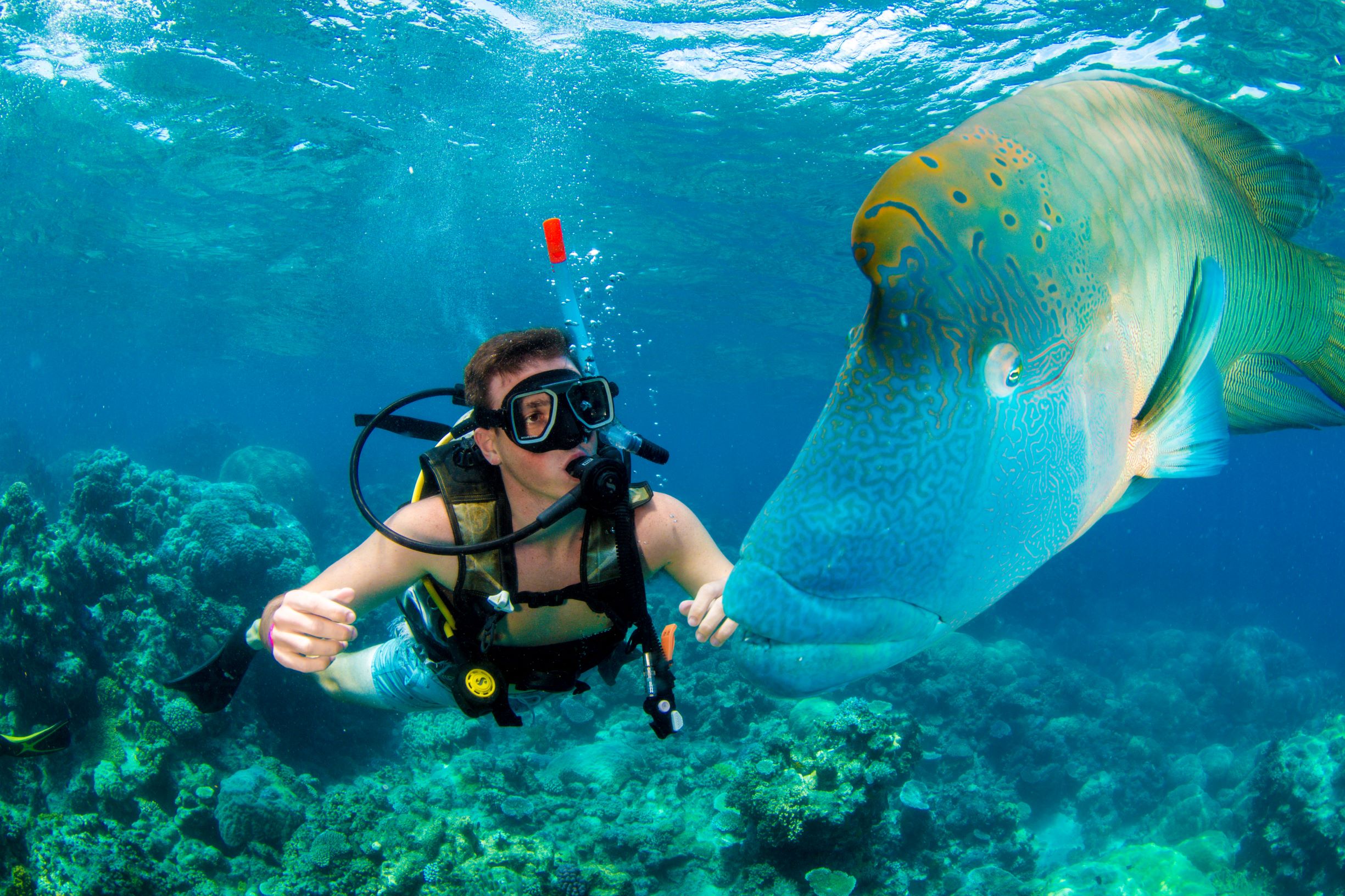
Day boat or liveaboard?
| Day boat | Liveaboard | |
|---|---|---|
| Dives per day | 2–3 | 3–5, including night dives |
| Travel time | 3 hours of your day, every day | Once, at each end |
| Reefs reached | Inner outer reef, 40–70 km | Further out, including the Ribbon Reefs |
| Cost | $275–$330 plus dive add-ons | From $625 for two days, mostly inclusive |
| Comfort | Home to a hotel each night | Bunk or cabin, shared spaces |
| Best for | One or two dives, mixed groups, non-divers along | Anyone doing more than three dives |
The arithmetic is straightforward. If you want more than about three dives, a liveaboard wins on both cost per dive and quality of diving, because you stop paying for the crossing every morning. If you're travelling with people who don't dive, a day boat is the only sensible answer. They can snorkel or use the glass-bottom boat while you're under.
For mixed groups, our reef tour comparison flags which boats handle divers and non-divers well on the same trip.
The medical form, and the rules that bite
Commercial diving in Queensland runs under a state recreational diving and snorkelling code of practice, and the paperwork is where it bites.
Declare everything on the medical questionnaire
It's stricter than the snorkelling version. Asthma, heart conditions, diabetes, epilepsy, recent surgery, pregnancy and some medications can mean you need a doctor's sign-off before you dive, or that you can't. Getting turned away at the dive deck is a bad morning; not declaring something is a genuinely bad idea.
Don't fly within 24 hours of diving
This is the rule people plan badly around. If your last day is a travel day, dive earlier in the trip or snorkel instead. It's also an argument for putting the reef at the start of your stay rather than the end.
Don't dive with a head cold
You won't be able to equalise, and forcing it hurts. Snorkel that day and rebook the dive.
Expect a briefing you actually have to listen to
Hand signals, buddy checks, the plan, the maximum depth and time, and how the boat will count you back on. Dive briefings on Cairns boats are thorough and they're not a formality.
Age limits are set by the operator
Introductory diving generally starts around 12 and certified diving from 12 with depth restrictions, but the specific rule varies by boat. We'll confirm it for your booking rather than guess.
Not sure whether to try a dive or just snorkel?
Most reef boats let you decide on the day, and the introductory dive is booked on board. Compare which boats are dive-led and which are snorkel-first before you pick.
Compare reef tours →The best time of year to dive the reef
You can dive here every month, but the conditions genuinely differ.
- August to December, the best window. Winds ease off from the mid-year trades, visibility is at its best, and water temperature is climbing. Coral spawning happens around the full moons of late spring.
- June to August, strongest trade winds. Best visibility of the year on the good days, but the most cancellations and the roughest crossings. Water around 23–24°C, so wear the wetsuit.
- January to March, wet season. Warmest water, calmest mornings, but rain can reduce visibility and it's cyclone season. Fewer boats and fewer people.
- Minke whale season, June and July, on liveaboard trips to the Ribbon Reefs, the only reliable place in the world to swim with dwarf minkes.
Stinger season, roughly November to May, doesn't stop diving: full-body suits are supplied free and you'd wear a wetsuit anyway. The detail is in our stinger season guide, and the month-by-month picture for the whole trip is in best time to visit Cairns.
How we know this
We're based in Cairns and we book dive days and liveaboards every week, so we know which boats are genuinely dive-led and which sell diving as an afterthought. Course structure and duration here come from PADI's own published guidance; reef sites and fares come from the operators' own pages. Where dive add-on pricing moves between operators, we've given ranges and pointed you to the operator page rather than invent a single figure.
General information, not medical advice. Declare all medical conditions on the operator's form and follow the dive briefing on the day.
Diving the Great Barrier Reef from Cairns: our verdict
If you've never dived, book a day boat and add an introductory dive for $90 to $158, no certification, an instructor beside you, and it will be the thing you remember. If you're certified, Silverswift's three sites in one day is the best day-boat value at $308. If you want more than three dives, stop paying for the crossing every morning and take a liveaboard. And whatever you book, don't put it within 24 hours of your flight.