The short answer
- The outer Great Barrier Reef is about 40–70 km offshore from Cairns, the popular pontoon sites sit around 47 km out.
- Boat time: 45 to 90 minutes each way, depending on the vessel and which reef it visits.
- Fastest option: half-day tours to the closest outer reef, about 45 minutes.
- Green Island and Fitzroy Island are much closer, roughly 45 minutes.
- You cannot see the reef from a Cairns beach. It's over the horizon; you need a boat.
This is one of the most-asked questions about a Cairns trip, and it matters more than it looks. The crossing is the part of the day people underestimate, it decides how much time you spend in the water, and whether seasickness becomes a factor.
Here's what the distances really are, how long each boat takes, and what that means when you're choosing a tour.
The distance, in kilometres and in minutes
The outer Great Barrier Reef sits roughly 40 to 70 kilometres off the Cairns coast. The reefs most day boats visit, Moore, Norman, Hastings, Saxon, Flynn, Milln, Thetford and Upolu, fall inside that band, with the well-known pontoon moorings around 47 km offshore.
In practice, distance matters less than the boat. A fast catamaran covers 47 km in about 90 minutes; a smaller fast vessel to a closer reef does it in 45. A sailing catamaran takes longer by design, because sailing is part of the point.
| Where you're going | Roughly how far | Boat time each way | What it is |
|---|---|---|---|
| Outer reef pontoon (Moore Reef) | ~47 km | ~90 min | Fixed platform, sheltered water |
| Outer reef sites (Norman, Saxon, Hastings) | ~40–70 km | ~75–90 min | Coral gardens, boat moorings |
| Outer reef dive sites (Flynn, Milln, Thetford) | ~40–60 km | ~75 min | Deeper walls, dive-focused |
| Upolu Reef (half-day trips) | closest outer reef | ~45 min | Sand cay and reef, short crossing |
| Michaelmas Cay | ~40 km | longer under sail | Sand cay and bird sanctuary |
| Green Island | ~27 km | ~45 min | Coral cay with fringing reef |
| Fitzroy Island | ~29 km | ~45 min | Continental island, fringing reef |
Crossing times are typical for the boats we book and vary with sea conditions.
Tap a pin for the distance and crossing time. Cairns sits on the coast; everything red is outer reef.
Quick picks
Pick by how long you want to be on a boat.
- Shortest crossingHalf-day outer reef, about 45 minSee half-day tours →
- Closest reef you can walk intoGreen or Fitzroy Island, about 45 minSee island tours →
- Best coral, longer runOuter reef full day, 75–90 minCompare reef tours →
On this page
Why the crossing time matters more than the distance
Two tours can both go "to the outer reef" and give you very different days. Work it through: a 90-minute crossing each way is three hours of travelling on an eight-hour tour. A 45-minute crossing is an hour and a half. That difference is either extra time in the water or extra time sitting on a boat.
The three things it affects:
- Water time. Shorter crossings generally mean more snorkelling, or a shorter overall day.
- Seasickness. This is the big one. If you're prone to it, a shorter crossing or a sheltered pontoon mooring makes an enormous difference. Take medication before boarding, not once you feel it.
- Number of sites. Boats with quicker crossings often fit in two or three reef sites; slower ones may do one or two.
If seasickness worries you: pick a half-day trip with a 45-minute run, or a pontoon where you're moored to a fixed platform in sheltered water for most of the day. Both make far more difference than any tablet.
Can you see the Great Barrier Reef from Cairns?
No, and this catches a lot of people out. From the Cairns Esplanade you're looking at a muddy tidal inlet, not coral. The reef starts tens of kilometres out, well beyond the horizon. Cairns is the gateway to the reef, not a view of it.
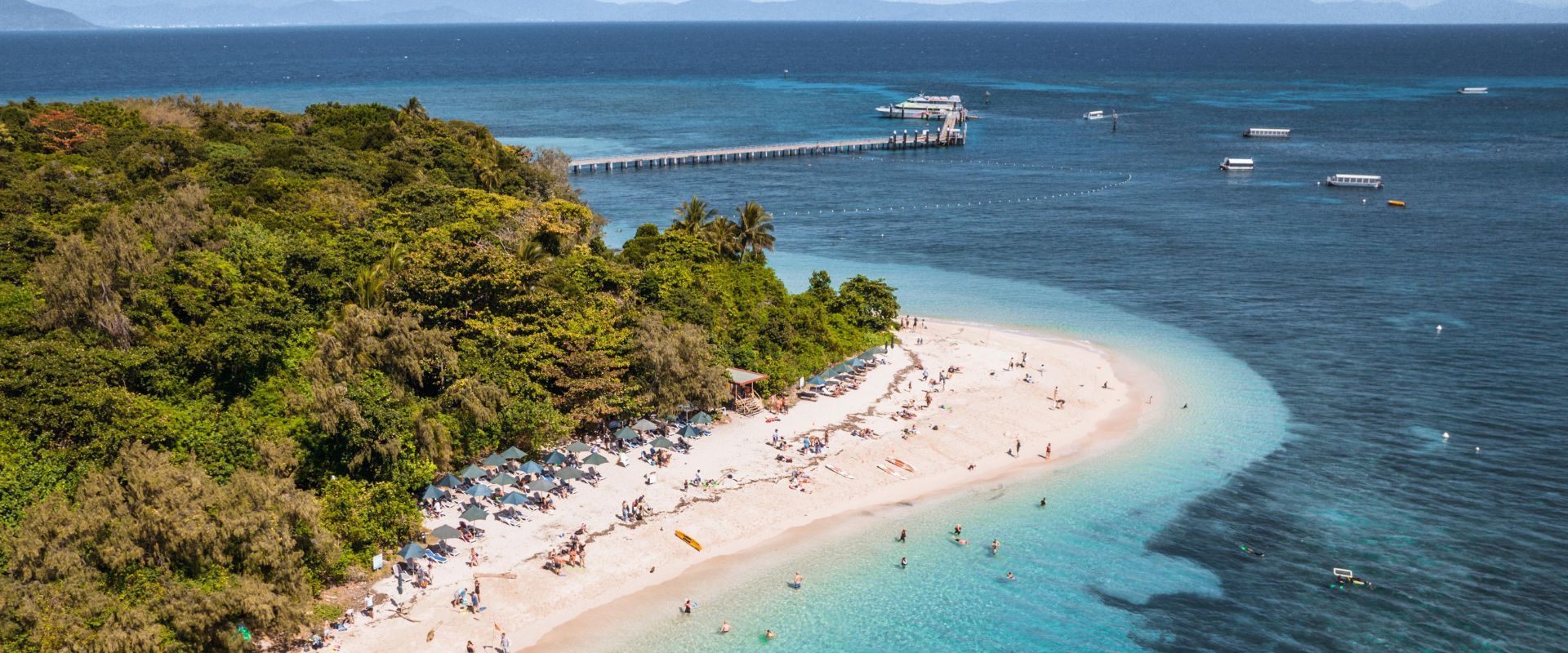
The city also has no coral beach of its own. If you want to snorkel straight off sand, you want an island day to Green Island or Fitzroy Island, both of which have fringing reef within wading distance.
Inner reef vs outer reef from Cairns
Worth understanding before you book, because the price gap is largely a distance gap.
Inner reef and island fringing reef
Closer in, around the islands. Shorter crossing, cheaper, calmer, and you can snorkel from a beach. Coral is decent but generally less dramatic, and visibility is more affected by run-off from the mainland.
Outer reef
The real thing: coral bommies, walls, better visibility and bigger marine life. It costs more and takes longer to reach, and you'll be snorkelling from a boat or pontoon rather than a beach.
If it's your one shot at the Great Barrier Reef, go outer. If you want a beach day with some snorkelling attached, an island is better value. We've compared them all on our island tours page, and there's a full Fitzroy vs Green Island comparison if you're torn between the two.

Want the shortest possible boat ride?
Half-day tours reach the outer reef in about 45 minutes, the best option if you're short on time or worried about seasickness.
See half-day reef tours →Does further out mean better coral?
Not automatically. Beyond the inner-versus-outer distinction, extra distance doesn't reliably buy better coral. What determines a good reef day is the specific site, recent weather, and how many other boats are moored there.
This is why the operators worth booking rotate between several sites rather than committing to one. It lets them pick the best conditions on the day instead of sailing to a fixed point regardless of what the water is doing.
Where reef tours leave from in Cairns
Almost all reef tours leave from the Reef Fleet Terminal on the Cairns Esplanade, in the middle of town. If you're staying in the CBD it's an easy walk, which is worth knowing because it saves the transfer fee.
Staying at the Northern Beaches, Palm Cove or Port Douglas? Add transfer time and cost, or consider a tour departing closer to you. Check-in is typically 30 to 60 minutes before departure, and boats don't wait.
How we know this
The crossing times here are the ones we quote guests, taken from the operators' own schedules and from riding these boats ourselves. Distances offshore are the reef locations the boats moor at, not straight-line figures from a map.
Sea conditions change crossing times. Treat these as typical, not fixed.
The short version on distance
The outer reef is 40–70 km offshore and 45 to 90 minutes by boat. Green Island and Fitzroy Island are closer, around 45 minutes, and are the only way to snorkel reef straight off a beach. You cannot see the reef from shore. If the crossing worries you, book a half-day trip or a pontoon rather than the longest run out, the reef you reach in 45 minutes is still the Great Barrier Reef.