The short answer
- Yes. Estuarine (saltwater) crocodiles live throughout the Cairns region, in rivers, creeks, estuaries and mangroves.
- They are not in the places tourists swim. The Esplanade Lagoon, hotel pools and the outer reef are not crocodile habitat.
- Sightings in the city are rare but real. Trinity Inlet and the creeks either side of Cairns are croc country, and that is exactly why nobody swims there.
- Never swim in a river, creek, estuary or mangrove channel: signs or no signs. That is the whole rule.
- Want to see one? A wildlife park guarantees it; a Daintree River cruise gives you a good chance of a wild one.
This is the question we get asked more than any other, usually a few days before someone flies in. The short version: yes, there are crocodiles here, and no, that is not a reason to change your plans.
What matters is understanding where they live, because the line between crocodile water and safe water in Far North Queensland is unusually clear. Locals swim here every day of the year. They just don't do it in a river.
Cairns sits inside Croc Country
Yes. Cairns sits well inside what Queensland officially calls Croc Country: the estuarine crocodile's natural range, which starts at the Boyne River near Gladstone and runs north to the Torres Strait and west across Cape York and the Gulf.
Estuarine crocodiles, the ones people mean by "salties", live in the tidal parts of rivers and creeks, in estuaries, and through the mangroves. Around Cairns that means Trinity Inlet, the Barron River, the Mulgrave and Russell rivers, the Daintree, and dozens of smaller creeks. They also swim in the sea between those places, which is why the government's own advice is that no waterway inside their range can be treated as crocodile-free.
The population across northern Australia runs into the hundreds of thousands of adults, and it has grown since crocodiles were protected in Queensland in 1974. Nobody publishes a "crocodiles in Cairns" number, and any site that gives you one is guessing.
Quick picks
See one safely, or swim somewhere they aren't.
- Guaranteed sightingHartley's Crocodile Adventures, hundreds of salties, plus the attack showSee the day →
- Wild crocodile, from a boatA Daintree River wildlife cruiseSee rainforest tours →
- Swimming with zero croc riskThe outer reef, 40–70 km offshoreSee reef tours →
On this page
Where the crocodiles live
The distinction that keeps people safe here is tidal versus non-tidal water. Crocodiles live in the tidal zone: anywhere the sea reaches up a river, plus the mangroves and mudflats along the coast. Above the tidal reach, up in the ranges where the creeks run fast and cold over granite, they are effectively absent.
That is why a local will happily swim at a rainforest swimming hole in the hills above Cairns and will not put a toe in the Barron River twenty minutes away.
| Water | Crocodiles? | Do people swim? |
|---|---|---|
| Trinity Inlet, Cairns harbour, boat ramps | Yes, resident | Never |
| Barron, Mulgrave, Russell, Daintree rivers | Yes, resident | Never |
| Mangrove creeks, mudflats, the Cairns foreshore | Yes, possible | Never (it's mud anyway) |
| Northern Beaches, Palm Cove, Four Mile Beach | Occasional sightings; crocs do swim in the sea | Yes, in stinger nets, and they close on a sighting |
| Esplanade Lagoon | No, enclosed, filtered, lifeguarded | Yes, all year |
| Rainforest swimming holes in the ranges | Above the tidal reach, not habitat | Yes, constantly |
| Green Island, Fitzroy Island beaches | Offshore islands; sightings very rare | Yes, daily |
| Outer Great Barrier Reef | No realistic risk | Yes. This is what reef tours do |
Where you can safely swim in Cairns
Cairns has no swimming beach in the city, the foreshore is a tidal mudflat. What it has instead is genuinely better for this problem.
The Esplanade Lagoon, free, and the obvious answer
A 4,800 m² filtered saltwater lagoon on the waterfront, lifeguarded from 6am to 9pm daily (it opens at midday on Wednesdays for maintenance). It is enclosed, so no crocodiles and no stingers, and it costs nothing. Depth runs from about 80 cm to 1.5 m, so it works for small children and for laps.
Rainforest swimming holes in the ranges
Crystal Cascades, Behana Gorge, Josephine Falls, Babinda Boulders and the crater lakes on the Tablelands sit above the tidal reach and are where locals swim. The real risk at these spots is not crocodiles. It's currents and slippery rock. Babinda Boulders in particular has a section (Devil's Pool) with a genuinely bad drowning history. Swim where the signs tell you to.
The netted beach enclosures, November to May
Palm Cove, Trinity Beach, Yorkeys Knob, Ellis Beach and Four Mile Beach in Port Douglas all have stinger nets in season, patrolled by lifesavers. The nets are for jellyfish, not crocodiles, but the beaches are patrolled, and they close them if a crocodile is reported. See our stinger season guide for how that season works.
The islands
Green Island and Fitzroy Island have real swimming beaches with reef straight off the sand. They're offshore, crocodile sightings there are very rare, and thousands of people snorkel off those beaches every week. Compare them on our island tours page.
The outer reef
40 to 70 km offshore in deep, open ocean. This is not crocodile habitat in any practical sense, and it's where every reef tour puts you in the water.
The one-line rule locals use: if the water is brown, tidal, or has mangroves anywhere near it, don't swim. If it's a lagoon, a rainforest creek in the hills, a netted beach or the reef, you're fine.
Are there crocodiles on the Great Barrier Reef?
Not in any way that should affect your plans. Crocodiles are coastal and estuarine animals. The outer reef sites that Cairns boats visit, Moore, Norman, Hastings, Saxon, Flynn, Milln, Upolu, sit 40 to 70 km offshore in open water. There is no habitat there: no fresh water, no mangroves, no shelter.
Crocodiles do occasionally swim well out to sea, and there have been rare sightings at inshore islands and cays. But no Cairns reef operator treats crocodiles as an operational risk, and no reef briefing you'll sit through mentions them. What the briefing does cover is currents, staying inside the marked area and how to signal the lookout, which is the actual safety story of a reef day. We've written it up in is it safe to snorkel the Great Barrier Reef.
If crocodiles are the thing making you nervous about the water, the reef is the answer, not the problem. Our reef tour comparison covers every boat that goes out there.
The Crocwise rules, in plain English
Queensland runs a public safety campaign called Be Crocwise, and the rules are short enough to remember. These are the official ones, translated out of government language:
- Expect crocodiles in every waterway, even without a warning sign. The absence of a sign means nothing.
- Obey the signs where they exist. They go up for a reason.
- Stay at least 5 metres back from the water's edge. A crocodile can reach the bank. If you have to be close, keep something solid, an esky, a rock, a tree stump, between you and the water.
- Don't stand on logs or branches overhanging the water and never wade in to free a snagged fishing lure.
- Keep your whole body inside the boat. No arms, no legs, no dangling anything.
- Be extra careful at night, and from September to April: the breeding season, when crocodiles are more active and more territorial.
- Bin your food scraps and fish frames. Feeding crocodiles, deliberately or by accident, is what turns a shy animal into a dangerous one. It's also illegal.
Crocodile sightings can be reported to the Queensland Department of Environment. If you see a crocodile somewhere it shouldn't be, report it. That's how problem animals get removed.
Where to see a crocodile on purpose
Plenty of people arrive wanting to see one. There are two honest ways to do it, and they suit different trips.
A wildlife park, guaranteed, and better for kids
Hartley's Crocodile Adventures on the coast road north of Cairns is home to hundreds of saltwater crocodiles. The wetlands boat cruise gets you close to big animals, and there's a crocodile attack show, cassowaries, snakes and koalas. Sightings are effectively certain, which matters if you have children who'll be disappointed by an empty river. We sell it as a full day combined with the Kuranda Scenic Railway and Skyrail, see the Kuranda and Hartley's day.
A Daintree River wildlife cruise, wild, and not guaranteed
A cruise on the Daintree River is the classic wild-crocodile experience: a small boat, a guide who knows which animals live on which bend, and mangroves either side. You often see them; you sometimes don't. Every one of our full-day Daintree tours includes a river cruise. Uncle Brian's Cape Tribulation day, Billy Tea's Daintree and Cape Trib tour with a full hour on the river, and Cairns Discovery's premium day. Compare them on the Daintree tours page.
Don't go croc-spotting on your own
Walking a riverbank at dusk looking for crocodiles is how people get into trouble. A guided boat is safer, better for photos, and you'll be shown animals you would never have spotted yourself.
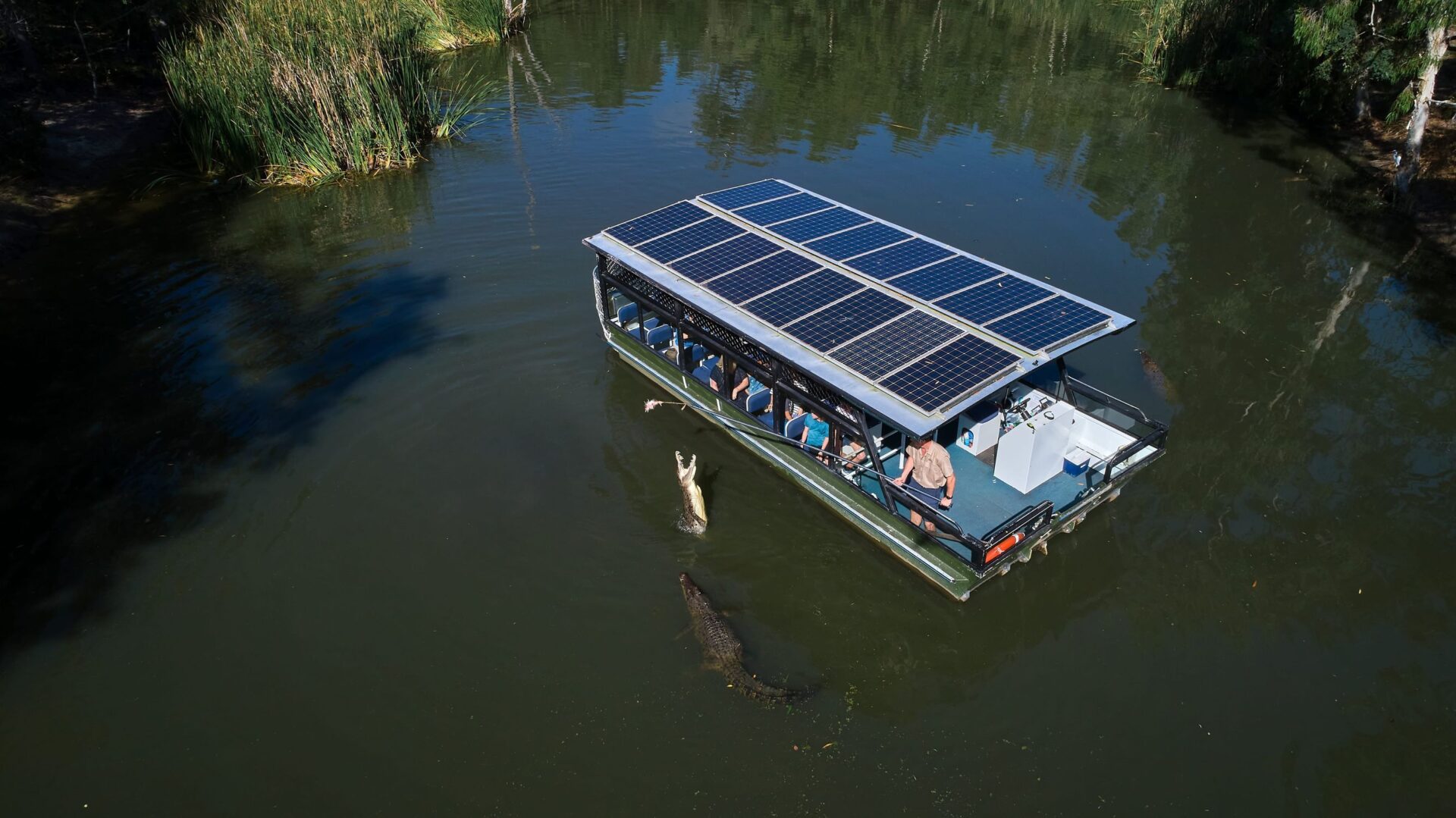
Want to see one without the guesswork?
Hartley's has hundreds of saltwater crocodiles and runs a wetlands boat cruise plus the attack show, packaged with the Kuranda rail and Skyrail as one full day.
See the Kuranda & Hartley's day →How worried should you be?
Honestly: not very, as long as you stay out of rivers and estuaries. Crocodile attacks in Queensland are rare, and the pattern behind them is consistent, people in or beside tidal water, often at night, often where a warning sign was already up.
Nobody gets taken off a reef pontoon. Nobody gets taken out of the Esplanade Lagoon. The risk lives in a very specific type of water, and avoiding that water costs you nothing, because it isn't nice to swim in anyway.
What we'd genuinely tell a nervous guest: the crocodiles are the easy risk to manage here. Sunburn, dehydration and getting out of your depth on a snorkel are the ones that actually catch people out.
How we know this
We live in Cairns, we book water-based tours every week, and we get this question constantly, usually from parents. So we'd rather answer it properly than reassure you into a bad decision. The safety rules below are Queensland's official Crocwise advice, not our interpretation of it.
Crocodile behaviour is not predictable. Treat every tidal waterway as occupied, and follow local signage over anything you read online, including this page.
Are there crocodiles in Cairns? Our verdict
Yes, and they are genuinely part of the landscape here, but they live in tidal rivers, creeks and mangroves, not in the places visitors swim. Use the Esplanade Lagoon in town, the rainforest swimming holes in the ranges, the netted beaches in season and the outer reef, and your crocodile risk is close to zero. If you want to see one, do it from a boat with a guide.