The short answer
- Crocodiles: guaranteed at a wildlife park, likely on a Daintree River cruise.
- Koalas and kangaroos: a park, not the wild. Nobody sees a wild koala here by accident.
- Platypus: Peterson Creek at Yungaburra or Tarzali Lakes, dawn or dusk, roughly April to October.
- Cassowaries: the wet edges of the Daintree and the Tablelands. Genuine luck, and keep your distance.
- Turtles and reef sharks: a routine sighting on almost any outer reef day.
Far North Queensland has the best wildlife in Australia and the worst hit rate, because most of it lives in dense rainforest and comes out at night. That gap between expectation and reality is worth managing before you arrive.
So this is organised by how likely you are to actually see something, not by how exciting it would be.
What you'll realistically see
| Animal | Where | How likely |
|---|---|---|
| Saltwater crocodile | Wildlife park | Certain |
| Saltwater crocodile | Daintree River cruise | Good chance |
| Green sea turtle | Outer reef, Green Island, sea kayak | Very likely |
| Maori wrasse | Outer reef sites | Very likely, they come to you |
| Reef sharks | Outer reef | Likely, and harmless |
| Koala | Wildlife park only | Certain in a park, never in the wild here |
| Kangaroo / wallaby | Granite Gorge, wildlife parks, Tablelands roadsides | Likely |
| Platypus | Peterson Creek, Tarzali Lakes | Good, at dawn or dusk, April–October |
| Cassowary | Daintree, wet Tablelands edges | Genuine luck |
| Tree kangaroo | Upper Tablelands | Rare |
| Minke whale | Ribbon Reefs, liveaboard, June–July | Reliable in season, but only up there |
| Fruit bats | Cairns city trees at dusk | Certain, thousands of them, free |
Ranked on what guests come back with, not on what's theoretically present.
Quick picks
Where to go for each animal, ranked by how certain the sighting is.
- Guaranteed animalsHartley's Crocodile Adventures, with the Kuranda daySee the day →
- Wild crocodile from a boatA Daintree River wildlife cruiseCompare tours →
- Turtles and reef sharksAny outer reef dayCompare reef tours →
On this page
Crocodiles
Two honest routes, and they suit different trips.
A wildlife park, for certainty. Hartley's Crocodile Adventures on the coast road north of Cairns keeps hundreds of saltwater crocodiles. There's a wetlands boat cruise on a lagoon full of them, a crocodile attack show, cassowaries, snakes and koalas. Sightings are effectively guaranteed, which matters enormously if you have children who won't forgive an empty river. There's also a Big Croc Feed encounter from $15 per person, with a minimum age of 16. We sell it as a full day with the Kuranda rail and Skyrail, see the Kuranda and Hartley's day.
A Daintree River cruise, for a wild one. A small boat, mangroves either side, and a guide who knows which animals hold which bend. You often see them; you sometimes don't. All three of our full-day Daintree tours include a river cruise. Billy Tea gives you a full hour on the water. Compare them on the Daintree tours page.
The safety side matters and it's simple: never swim in a river, creek, estuary or mangrove channel, and stay five metres back from the water's edge. Crocodiles are more active at night and during the September to April breeding season. Full detail in crocodiles in Cairns.
Reef wildlife: the most reliable of the lot
People plan whole trips around a rainforest animal they probably won't see, and then are surprised by how much they see underwater. The reef is where the hit rate is.
- Green sea turtles: common at outer reef sites, off Green Island, and on the Palm Cove sea kayak trip, where they're a routine sighting rather than a lucky one.
- Maori wrasse: enormous, curious and habituated at the popular moorings. They will swim up to you.
- Whitetip and blacktip reef sharks: small, shy and a highlight. Not something operators treat as a risk.
- Giant clams, parrotfish, clownfish: standard on any coral garden site.
- Dwarf minke whales: June and July, on liveaboard trips to the Ribbon Reefs. This is the only reliable place in the world to swim with them, and it isn't a day trip. See our diving guide.
If wildlife is why you're coming, a reef day is a better bet than a rainforest day. Compare the boats on our reef tours page.
Rainforest animals, and the honest odds
The Daintree and the Tablelands hold extraordinary animals. You will see almost none of them from a coach in daylight.
What improves your odds:
Go at dawn or dusk, not midday
Almost every mammal here is crepuscular or nocturnal. A midday boardwalk gives you birds, insects and plants, which is genuinely interesting, but it isn't mammals.
Take a guided night walk
Spotlight walks on the Tablelands and in the Daintree find possums, tree frogs, gliders and occasionally a tree kangaroo. This is the single biggest reason to stay overnight up there rather than day-trip.
Stay still
The commonest mistake. Guides find animals because they stop and look, and groups that keep walking see nothing.
Use a guide who knows the specific site
A local guide knows which fig the cassowary uses and which bend the crocodile holds. That knowledge is most of the difference between a sighting and a walk.
Look down and up, not ahead
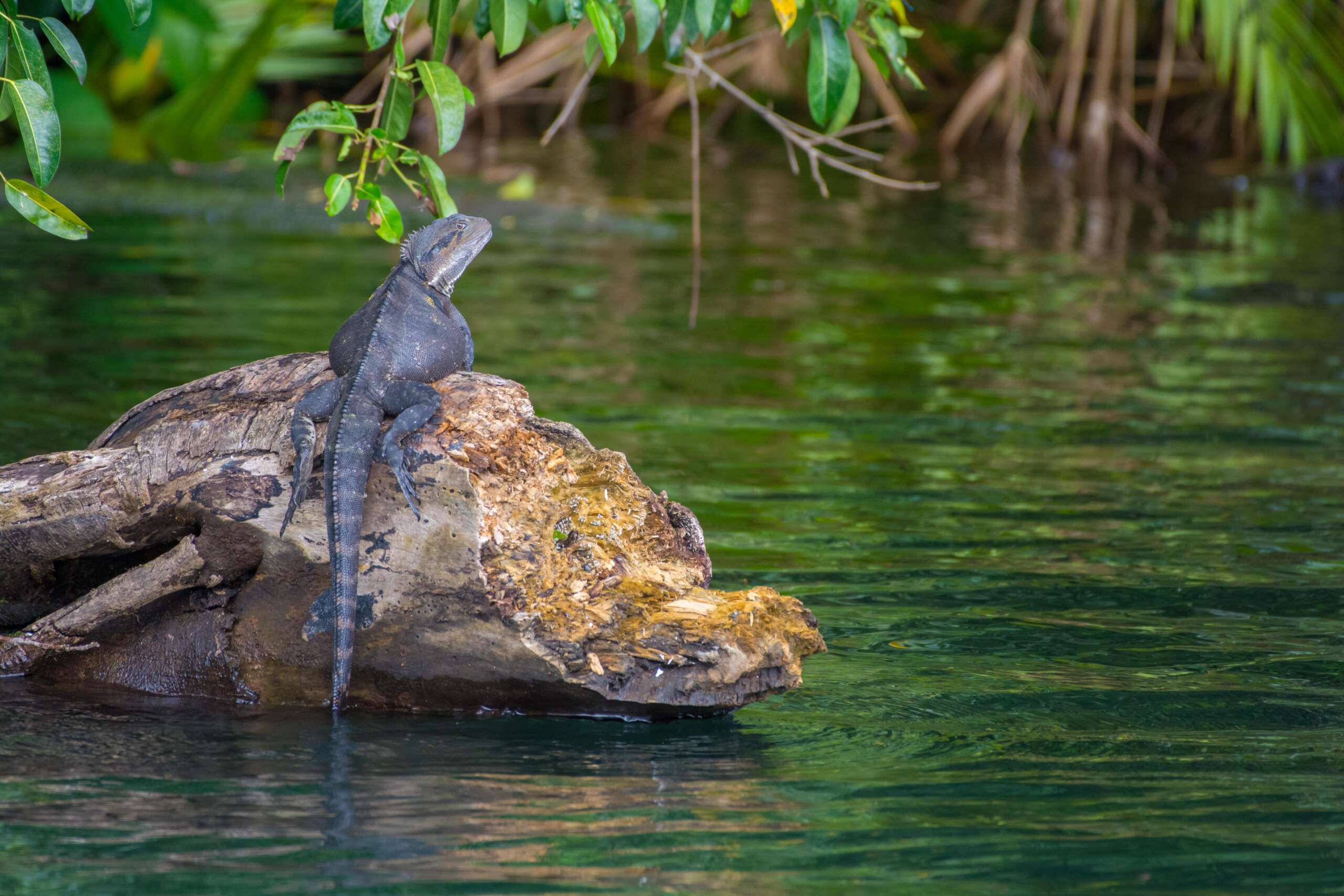
Boyd's forest dragons sit vertically on trunks at eye level and are invisible until they aren't. Most people walk straight past them.
Platypus: the best wildlife bet on land
Genuinely achievable, and one of the more special things you can do here.
Peterson Creek at Yungaburra on the Atherton Tablelands is the reliable spot, with Tarzali Lakes a close second. The season runs roughly April to October, and the time is dawn or dusk.
The technique: find the viewing platform, sit down, stop talking, and watch for rings on the water rather than for an animal. They surface for a few seconds at a time. Twenty patient minutes usually does it.
Several Tablelands tours build in a platypus stop. See our Tablelands guide for the rest of the region, and note it's another argument for staying a night at Yungaburra.
Cassowaries
A 1.8-metre flightless bird, and the animal most visitors most want to see. Your odds are real but modest: the wet eastern edges of the Daintree and the Tablelands are the habitat, and roadsides at Mission Beach and Cape Tribulation produce most sightings.
Two rules if you're lucky. Don't approach and don't feed: a fed cassowary becomes a dangerous one, and it's illegal. And if one walks towards you, put a tree between you and back away slowly. They're generally shy, and they are also large animals with a serious kick.
If a rainforest animal is the whole reason for your trip, book a wildlife park as well as a rainforest day. The park guarantees the photograph; the rainforest gives you the chance of the real thing. Doing only the second is how people go home disappointed.
Wildlife parks, and why they're not cheating
There's a snobbery about wildlife parks that we'd push back on. Australian rainforest animals are cryptic and nocturnal; a park is how most people ever see a koala, a cassowary or a large crocodile at all.
- Hartley's Crocodile Adventures: the region's best-run park, north of Cairns. Crocodiles, the wetlands cruise, cassowaries, koalas and snake shows.
- The Kuranda attractions: Koala Gardens, Birdworld and the Butterfly Sanctuary sit together near the Heritage Markets, and they fill village time neatly on a Kuranda day.
- Granite Gorge on the Tablelands: rock wallabies that will feed from your hand, plus a granite creek. A private reserve, so there's an entry fee.
- Cairns Aquarium: in the city, open 9:30am to 3:30pm with last admission at 2:30pm, general admission from $61 and about two hours suggested. There are also turtle rehabilitation centre tours from $20, for ages 3 and up. The obvious wet-weather answer with children.
Best time of year for wildlife
- April to October: platypus season, and the drier months make walking and spotlighting easier.
- June and July: dwarf minke whales on the Ribbon Reefs, liveaboard only.
- September to April: crocodile breeding season, so more visible activity and more reason for caution.
- The wet season, January to March: frogs, insects and birds are at their peak, and the forest is at its loudest. Harder walking, better soundtrack.
- Late spring: coral spawning happens around the full moons, which is a genuinely strange thing to be in the water for.
The month-by-month climate picture is in Cairns weather by month.
Want the guaranteed version and the wild version?
The Kuranda and Hartley's day gives you certain crocodiles, cassowaries and koalas; a Daintree day gives you the chance of a wild one from a boat. Most people are happiest doing both.
See the wildlife day →How we know this
We book wildlife-focused days constantly and we hear what guests saw, which is why this page is ordered by likelihood rather than by how impressive the animal is. Park inclusions and prices are the operators' own; the crocodile safety guidance follows Queensland's official Crocwise advice.
Wildlife sightings are never guaranteed outside a park. Seasons shift year to year.
Wildlife around Cairns: our verdict
Manage the expectation and you'll have a much better time. Crocodiles, koalas and cassowaries: go to a park: Hartley's is the best of them, and there's no shame in it. A wild crocodile: take a Daintree River cruise. Platypus: Peterson Creek at Yungaburra, dawn or dusk, April to October. And the animal you're most certain to see up close is a green turtle on a reef day, which is not what most people expect when they arrive.