The short answer
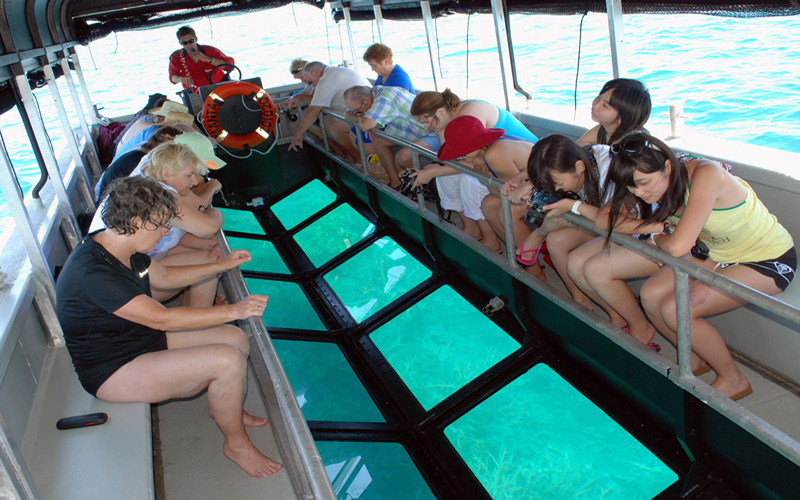
- You can see the Great Barrier Reef without getting in the water. Properly, not as a consolation.
- Book a pontoon. Glass-bottom boat, semi-submersible, underwater observatory, all included.
- If you'll try snorkelling, ask for a pool noodle and a flotation vest: both are standard.
- You can also do an introductory scuba dive without being able to swim well; an instructor holds you.
- Tell the crew at the briefing. They'd rather set you up than watch you struggle.
A lot of people quietly write off the Great Barrier Reef because they can't swim, or can't swim well, or had a bad experience in water once and never went back. It's the saddest cancellation we deal with, and it's completely unnecessary.
The reef tourism industry here was built around exactly this. Here's what's available and how to book it.
Four ways to see the reef without getting wet
| What you see | Where it's available | |
|---|---|---|
| Glass-bottom boat | Coral gardens and fish directly beneath you, with commentary | Pontoon and island tours |
| Semi-submersible | Seated below the waterline behind large windows, moving over the reef | Pontoon tours |
| Underwater observatory | A fixed window into the reef, at your own pace | Some pontoons |
| Helicopter or scenic flight | The reef from above, structure rather than fish | Add-on from Cairns |
All four are dry. The first three are usually included in a pontoon ticket rather than charged as extras.
The semi-submersible is the one that surprises people. You're sitting in an air-conditioned hull below the surface with windows the size of a car windscreen, moving slowly over coral bommies with a guide talking. It is not a poor substitute for snorkelling; it's a different and genuinely good way to see the reef, and it's easier to look at detail from a seat than while floating.
Quick picks
Three ways onto the reef that don't require you to be a swimmer.
- Best if you won't swim at allA pontoon, three dry ways to see coralSee the day →
- Best if you'll try, with supportA pontoon lagoon entry plus a guided snorkelSee the day →
- Best short introductionA half-day trip to a sheltered reefSee half-day tours →
On this page
Why a pontoon is the answer
A pontoon is a large fixed platform moored permanently at a reef. It doesn't move with the swell the way a boat does, and it has facilities a boat can't carry.
For a non-swimmer, that means:
- Three dry ways to see coral: glass-bottom boat, semi-sub and usually an observatory, all included in the ticket.
- A shallow lagoon with steps, so if you decide to try, you walk in to waist depth rather than jumping off a ladder into open ocean.
- Shade, seating, toilets and freshwater showers, so a full day out there is comfortable.
- Somewhere to be while the rest of your group snorkels, instead of sitting on a moving deck for two hours.
Pontoon days run around $317–$360 per adult, which is at the upper end of reef pricing, and for a non-swimmer it's the only ticket that gives you a full day's worth. Reef Magic and Sunlover are the two we book most.
If you'll try snorkelling: what to ask for
Snorkelling is not swimming. You float face-down and breathe; you barely move. Plenty of people who describe themselves as non-swimmers have a completely successful snorkel once they're set up properly.
What to ask for, by name:
A flotation vest
An inflatable vest you can adjust in the water. You cannot sink in one. Under Queensland's snorkelling code of practice, snorkellers assessed as higher risk are required to wear a flotation device, and on many boats a differently coloured vest or snorkel so the lookout can pick you out from the deck. It's routine, not a judgement.
A pool noodle
The most underrated piece of reef equipment in Australia. Tuck it under both arms and you're stable, upright when you want to be, and can look down without effort. Ask for one even if nobody offers.
A lifejacket
If you'd rather not think about buoyancy at all. Every boat carries them.
The guided snorkel tour
A marine guide leads a small group on a set route, usually towing a float ring you can hold onto the whole way. On most boats it's either free or a small add-on. For a nervous or non-swimmer, this is the single best thing on the ticket.
The lagoon, not the ladder
On a pontoon you can stand up in the shallow end with your mask on and put your face in while holding the edge. Thirty seconds of that and most people's nerves settle.
The one tip that changes everything: put your face in the water and breathe through the snorkel while you're still holding onto something solid. The panic moment is the first breath, not the water. Get that out of the way at the steps and the rest follows.
Diving without being a strong swimmer
This sounds backwards and it's true: an introductory scuba dive can be easier than snorkelling for a weak swimmer.
On an intro dive you're not floating on the surface managing your own buoyancy. An instructor is holding you, controlling your depth, and you're breathing steadily from a regulator in shallow water. No certification is needed, group sizes are usually one instructor to two or four guests, and it typically runs 20 to 30 minutes.
The catch is the medical questionnaire, which is stricter than the snorkelling one. Asthma, heart conditions, recent surgery, pregnancy and certain medications may need a doctor's clearance. Declare everything. And remember you cannot fly within 24 hours of diving. Full detail in our diving guide.
The rules that protect you
Worth knowing, because they're the reason this is safe rather than a leap of faith. Commercial snorkelling in Queensland runs under a state recreational diving and snorkelling code of practice. In practice that means:
- A medical questionnaire before you get in. Answer it honestly; vagueness works against you.
- A compulsory briefing covering the marked area, hand signals and how to attract attention.
- Dedicated lookouts whose only job is watching people in the water.
- Flotation devices for anyone assessed as at-risk, and high-visibility gear so the lookout can track them.
The signal if you get tired: roll onto your back, float, raise one arm. Someone will come to you. More on all of this in is it safe to snorkel the Great Barrier Reef.
What to avoid booking
- A three-site dive-led boat. Excellent coral, and nothing to do between moorings if you're not in the water. Eight hours on a moving deck is a long day.
- A sailing catamaran, unless the sailing itself appeals. They're lovely and they have no dry viewing options.
- The cheapest ticket. On a non-swimmer's day, facilities are the product. This is not where to economise.
- A liveaboard. Obviously.
If cost is the constraint, a Green Island day from around $122 is the better budget answer than a cheap outer-reef boat: there's a beach, shade, a pool, rainforest boardwalks and glass-bottom boat options, so a non-swimmer has a real day. See our island tours page.
Non-swimming children
Same answer, more strongly: book a pontoon. Children snorkel in a flotation vest as a matter of course on most boats, the lagoon lets them stand up, and the glass-bottom boat and semi-sub mean a child who refuses the water still has a full day.
Reef Magic carries infants aged 0 to 3 free, with child fares from 4. The full family version of this is in Cairns with kids.
Tell us who's coming and how they feel about water
We'll match you to the boat that fits, including whether it has a semi-submersible, a lagoon entry and a guided snorkel, and how many passengers are booked on your date.
Compare reef tours →How we know this
We book reef days for guests who tell us upfront that they can't swim, most weeks. The equipment list here is what these operators actually hand out, and the regulatory points are Queensland requirements rather than our interpretation.
General information, not medical advice. Declare all medical conditions on the operator's form and follow the crew's instructions.
The Great Barrier Reef for non-swimmers: our verdict
You do not need to swim to see the Great Barrier Reef, and you shouldn't let it stop you booking. Book a pontoon: the glass-bottom boat, semi-submersible and observatory are included, and the shallow lagoon means you can try snorkelling standing up if you decide to. Ask for a pool noodle and a flotation vest by name, take the guided snorkel, and tell the crew at the briefing. They deal with this every single day.